Emerge | Commons
This year I was fortunate to have the opportunity to contribute to the performance schedule of ASU's conference about art, science, and the future. This is the second year that Emerge has happened at ASU, with the final night being a culminating festival of performance and art. In the Fall of 2012 I worked with a group of artists to put together a proposal for creating a performance in Neeb Plaza on ASU's campus. This courtyard that sits nestled between Neeb hall, the Art building, and Design houses a new student generated installation called X-Space each year. Looking to solicite the creation of new works, the Herberger institute put out a call for artists interested in organizing a performance that occurs in X-Space. Called X-Act, applicants were asked to consider hw they would use the space and engage the campus. Early in January my team found out that we our proposal, Commons, was selected. One of the stipulations of the grant was that we would have a showing during the final showcase of Emerge. With this news in mind, our team started the process of creating the installation we had proposed.
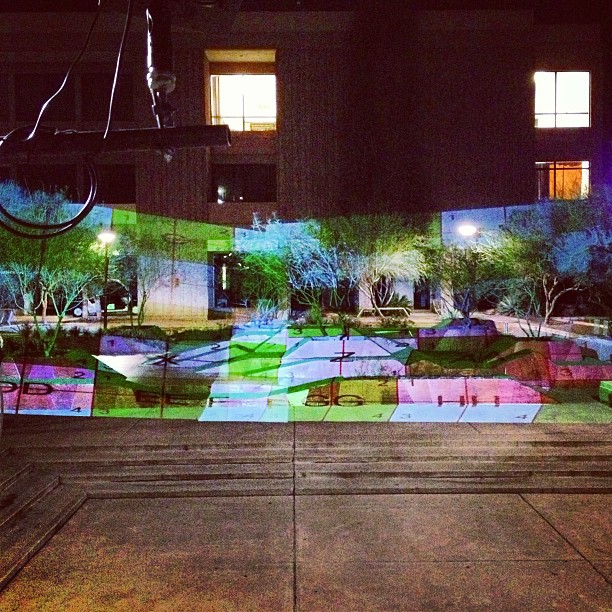
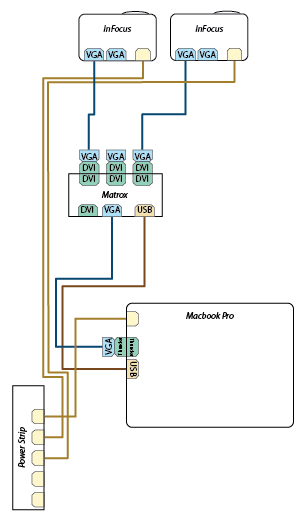
One of the elements that our team was committed to realizing was finding a way to integrate projection into the performance on this very geometrically interesting space. I started by measuring the physical dimensions of the space in order to determine the distance required for the projectors that I had available for this project. Using a bit of math one can calculate the throw distance of a projector. Alternatively it's also easy to use Projector Central's Projection Calculator in order to lock down approximate distances that you might need. With the numbers in front of me I was able to start making a plan about potential projector placement, as well as my options for the performance given the constraint of the size of image that I could create. With the limitations of distance roughly mapped out I headed to the space after dark to do some initial tests. The hard truth about the amount of ambient light in the plaza, and the limits of the InFocus projectors meant that I needed to shy away from projecting large in favor of being brighter. The compromise of brightness and size was to map the front surfaces of X-Space. To accomplish this, I needed to connect two projectors with a Matrox TripleHead. This piece of equipment allows for multi-monitor work where the computer sees the two projectors as though they were a single canvas.
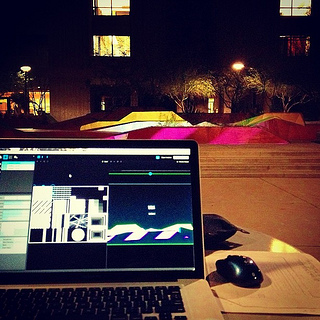
It took about 4 hours to pull of the necessary equipment, install, and focus the projectors. Once I had the projectors up and in place I was finally able to start mapping the surfaces. I had decided early on that I was going to use a piece of software called Modul8 to control my media playback. Modul8 is a VJ software software package that's robust and easy to use. Unlike other pieces of software, Modul8 is more like an instrument than an autonomous agent that can run independently. While there are a bunch of functions that you can automate inside of the software, it's largely built around the idea of live-mixing the media that you're using. In terms of automation, Modul8 allows the operator to use audio input to control a number of playback triggers. For this project the team used a track by DJ Earworm for audio, largely motivated by the desires of the group recruited for the dance performance. One of the additional benefits of Modul8 is it's ability to send Syphon out media. This means that this piece of playback software can be easily integrated with the mapping tool MadMapper. Here it was as important to know what media system (projectors, hardware, and software) I was using, as the conceptual idea around the performance itself.
After getting the hardware installed I started mappping the surfaces of X-Space, creating individual quads and masks for each plane. All in all it took me about three hours to create the maps and masks for the architecture. At this point I was finally able to start experimenting with what kind of media I wanted to use, and how I wanted to arrange it in the space. All in all I budgeted about 16 hours to get this project up and running. Implementing the plan I had created ended up taking about 16.5 hours. This meant that I had one night where I worked on this installation until 3:15 AM, and another night where I was working until just before midnight. We also had a rather unfortunate miscommunication with the Emerge planning staff about this installation, and the importance of having a security guard available to monitor the site over night. Installation started on Thursday evening, and each of the team members took a shift over night to monitor the outdoor equipment. Luckily we ended up with security for the second night, and didn't have to pull any more all-nighters.
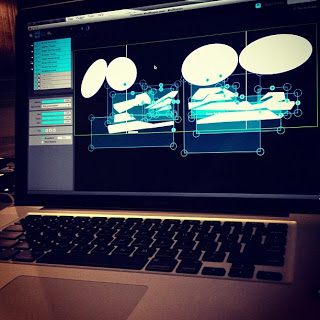
Finally, while this project looked beautiful on the empty space, there was a miscommunication about audience placement and how stanchions were going to be used at the actual event. While the team had discussed the importance of roping off the performance space, that request was lost on the actual event planners. Consequently the audience largely obstructed the projections as they used the actual stage space as seating. Additionally, the space was filled with stage lighting and projectors rented for another performance which only served to wash-out Commons media, and distract audience members. While this was certainly not a failure, it did leave a lot to be desired given the time, planning, and sleepless nights that implementation required. It's just another lessoned learned, even if learned the hard way.
Tools Used
- Programming and Playback- Modul8
- Mapping – MadMapper
- Projector – Two InFocus IN2116 DLP Projectors
- Multi-Monitor Control – Matrox TripleHead2Go Digital
- Video Editing – Adobe After Effects
- Image Editing – Adobe Photoshop
- Documentation – iPhone 4S, Canon 7D
- Editing Documentation – Adobe Premiere, Adobe After Effects