TouchDesigner | Sculpture
In the ever growing list of tools that I'm experimenting with Derivative's TouchDesigner is a tool that time and again keeps coming up as something that's worth learning, experimenting with, and developing competencies around it's work flow. TD is a nodal environmental called a network. Inside of the network nodes can be directly connected by by exporting parameters.
Nodes, also called Ops (Operations) are split into families specific to the characteristics of their behavior: CHOPS (Channel Operators), TOPS (Texture Operators), SOPS (Surface Operators), MATS (Materials), and DATS (Data Operators). Nodes from within the same families can pass data directly to one another through patch cords (similar to MaxMSP and Isadora). The output of nearly every node can be passed into other nodes by exporting parameter values. This process divides the process of passing data values into two distinct processes, one that's centered around like to like processes and one that's about moving from like to different.
TouchDesigner's nodes are the most powerful when they're connected. Like Max single nodes do little by themselves, and are the most powerful when they're connected. Also like Max the flexibility of TD is it's ability to build nearly anything, and with that comes the fact that little is already built. Similar to Isadora is the native ability to build user interfaces as a part of the very fabric of building a program / user experience.
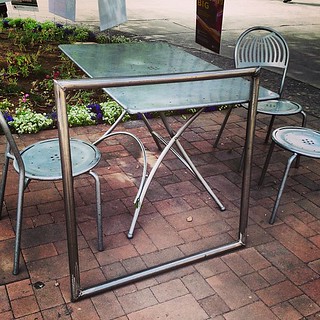
One of the projects that I'm working on this semester is for a sculpture course. This course, called New Systems, is intended to address the link between media and sculpture. One of the areas that I'm interested in exploring is about collecting data from a circus apparatus and using that to drive a visualization in performance. I'm most interested in the direct link between how an apparatus is behaving and how that data can be interpreted in other ways. To that end this semester I set to the work of building an apparatus and determining how to parse that data. In my case I decided to use this opportunity to experiment with TouchDesigner as a means of driving the media. While I was successful in welding together a square from stainless steel, after some consultation from my peers in my sculpture course it was determined that this structure was probably not safe to perform on. Originally I had planned to use a contact mic to capture some data from my interaction with the apparatus, and after a little bit of thinking and consultation with my adviser (Jake Pinholster) I decided that gyroscope data might be more useful.
My current plan is to move away from this being a performance apparatus and instead think of it as installed sculptural piece that serves as a projection surface. For data I'll be using an iPod Touch running Hexler's touch OSC. Touch OSC passes data using UDP packets to communicate over a wired or wireless network using Open Sound Control (OSC). One of the many things that Touch OSC can do is pass the accelerometer data from an iOS device out to other applications. In my case Touch OSC is passing this information to TouchDesigner. TD is then used to pull this information and drive some of the media.
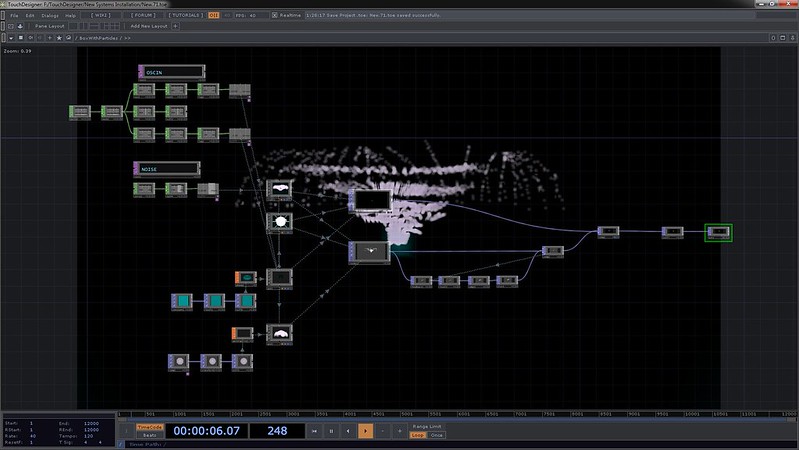
One of the challenges that my adviser posed in this process was to create three scenes that the media moved through. For the sake of experimentation I applied this challenge to the idea of working with containers in TouchDesigner. Containers are a method of encapsulation in TD, they're a generic kind of object that can hold just about any kind of system. In my case I have three containers that are equivalent to different scenes. The time line moves the viewer through the different containers by cross-fading between them. Each container holds it's own 3D environment that's rendered in real time and linked to the live OSC inputs coming from an iPod touch.
The best way to detail the process of programming this installation is to divide it up into the component pieces that make it all work. The structure of this network is defined by three hierarchical levels: