TouchDesigner | 3D solutions for a 2D world

· 11 min read
Matthew Ragan
Pixel Pusher

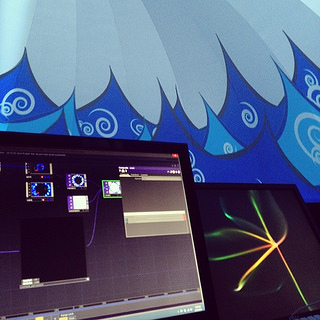
One of the fascinating pieces of working in TouchDesigner is the ability to use 3D tools to solve 2D problems. For the last seven months or so I've been working on Daniel Fine's thesis project – Wonder Dome. Dome projection is a wild ride, and one of the many challenges we've encountered is thinking about how to place media on the dome without the time intensive process of pre-rendering all of the content specifically for this projection environment. To address some of these issues we started working with Los Angles based Vortex Immersion Media, their lead programmer is the TouchDesigner specialist Jeff Smith of Eve Vapor.

Production image

TouchDesigner | Animation COMP

· 12 min read
Matthew Ragan
Pixel Pusher

The needs of the theatre are an interesting bunch. In my time designing and working on media for live productions I've often found myself in situations where I've needed to playback pre-built content, and other times when I've wanted to drive the media based on the input of the performers or audience. There have also been situations when I've needed to control a specific element of the media, while also making space for some dynamic element.

Interface Building – Execute DATs | TouchDesigner

· 8 min read
Matthew Ragan
Pixel Pusher

Sometimes it's easy to forget about the most obvious features of a device. In my case, I finally decided to do some investigating about the nature and function of the LAN port on the back of an InFocus 2116. It is not uncommon to see projectors with network access ports these days but I had always assumed that they only worked with the access software that the manufacturer is looking to sell / distribute. InFocus produces a free piece of software called ProjectorNet that's designed to give system admins quick access to the settings and status of connected projectors. This seems like a handy piece of software, but just wasn't something I had been in a position to review or experiment with. Last week when I finally gave myself some time to look at my LAN options for this InFocus, I noticed something when I booted up the machine – in a rather unassuming way, the projector was listing an IP address on the lamp-up screen.

Production image

Multiple Windows | TouchDesigner

· 4 min read
Matthew Ragan
Pixel Pusher

For an upcoming project that I'm working on our show control needs to be able to send out video content to three different projectors. The lesson I've learned time and again with TouchDesigner is to first start by looking through their online documentation to learn about what my options are, and to get my bearings. A quick search of their support wiki landed me on the page about Multiple Monitors.

Production image

AutoCAD and Dynamic Blocks for Media Designers

· 4 min read
Matthew Ragan
Pixel Pusher

This semester (Fall 2013) I decided to take an AutoCAD course taught by ASU's Jennifer Setlow. Jen's course is primarily designed to serve lighting and scenic designers. That said, it's already proven to be an invaluable experience for a media designer as it's exposed me many of the models and methods that a lighting designer would use when creating a lighting plot.

TouchDesigner | Import from a System Folder

· 10 min read
Matthew Ragan
Pixel Pusher

One of the handy building blocks to have in your arsenal as you're working with any media system is an understanding of how it works with system folders. Isadora, for example, pulls assets from the folder specified when you load the original file. This means that you can change an asset, save it with the same name and in placing it in the proper system folder your changes show up without having to re-import any files. What then, if I want to automatically pull files from a folder on my computer? In TouchDesigner that's a relatively simple thing to accomplish without too much work. Better yet, the underlying principles open up a lot of much more interesting possibilities.

Production image

WonderDome | Workshop Weekend 1

· 12 min read
Matthew Ragan
Pixel Pusher

WonderDome

In 2012 Dan Fine started talking to me about a project he was putting together for his MFA thesis. A fully immersive dome theatre environment for families and young audiences. The space would feature a dome for immersive projection, a sensor system for tracking performers and audience members, all built on a framework of affordable components. While some of the details of this project have changed, the ideas have stayed the same – an immersive environment that erases boundaries between the performer and the audience, in a space that can be fully activated with media – a space that is also watching those inside of it.

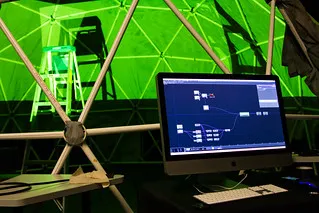
Fast forward a year, and in mid October of 2013 the team of designers and our performer had our first workshop weekend where we began to get some of our initial concepts up on their feet. Leading up to the workshop we assembled a 16 foot diameter test dome where we could try out some of our ideas. While the project itself has an architecture team that's working on an portable structure, we wanted a space that roughly approximated the kind of environment we were going to be working in. This test dome will house our first iteration of projection, lighting, and sound builds, as well as the preliminary sensor system.
Production image