Sending and Receiving OSC Values with TouchDesigner

· 7 min read
Matthew Ragan
Pixel Pusher

Production image

The other day I posted look at how to send and receive TouchOSC data with Troikatronix's Isadora. In an effort to diversify my programming background I'm often curious about how to translate a given task from one programming environment to another. To this end, I was curious about repeating this same action in Derivative's TouchDesigner. If you're one of a growing number of artists interested in visual programming, VJing, media design, interactive system design, media installation, or media for live performance than it's well worth your time to look at both Isadora and TouchDesigner.

Cue Building for Non-Linear Productions

· 7 min read
Matthew Ragan
Pixel Pusher

The newly devised piece that I've been working on here at ASU finally opened this last weekend. Named "The Fall of the House of Escher" the production explores concepts of quantum physics, choice, fate, and meaning through by combining the works of MC Escher and Edgar Allen Poe. The production has been challenging in many respects, but perhaps one of the most challenging elements that's largely invisible to the audience is how we technically move through this production.

Production image

Custom Quartz Compositions in Isadora

· 13 min read
Matthew Ragan
Pixel Pusher

Custom Quartz Compositions in Isadora

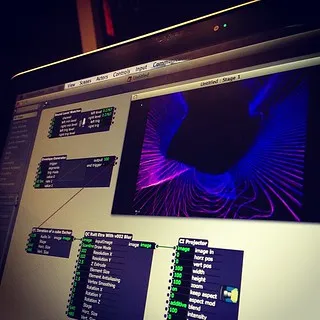
The more I work with Isadora, the more I feel like there isn't anything it can't do. As a programming environment for live performance it's a fast way to build, create, and modify visual environments. One of the most interesting avenues for exploration in this regard is working with Quartz Composer. Quartz is a part of Apple's integrated graphics technologies for developers and is built to render both 2D and 3D content by using the system's GPU. This, for the most part, means that Quartz is fast. On top of being fast, it allows you access to GPU accelerated rendering making for visualizations that would be difficult if you were only relying on CPU strength.

Production image

Compound Time

· 5 min read
Matthew Ragan
Pixel Pusher

Any instructor that spends any amount of time fighting with a grade-book can vouch for the truth that any method to save time when dealing with simple repetitive tasks is worth its weight in gold. Even something that costs you as little as 5 seconds per student per assignment can add up quickly. For example, if you take a course like the one I'm currently working on at ASU. A course of 48 students with 8 major assignments that require a rubric-like report. Copying and pasting may be a quick solution when moving back and forth between the LMS (Learning Management System) and a spreadsheet, but at a transaction cost of 5 seconds that's 96 minutes over the course of the semester.

Production image

Book Keeping

· 7 min read
Matthew Ragan
Pixel Pusher

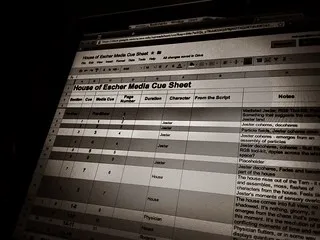
Not all of the work of media design is sexy. In fact, for all of the excitement generated by flash of stunning video, interactive installations, and large scale projection there is a tremendous amount of planning and paper work involved in the process. In the case of a theatrical project, one of the designer's crucial pieces of work comes in the form of creating a cue sheet. For the uninitiated, a cue sheet is a list of all of the moments in a show that contain media. These documents help the designer, stage manager, and director establish a common understanding about how media / lights / sound are going to be used in a given production.

Production image

Escher Image and Animation Research

· 3 min read
Matthew Ragan
Pixel Pusher

In thinking about what the media and animation for The Fall of the House of Escher might look like I've been sifting through the internet this summer looking for images that abstractly represent the universe and the behavior of particles and waves. Some of the more interesting work that I've found uses simple geometric shapes, and particle systems to evoke a sense of scale and distance and perspective. The work of the motion graphics designer Mr. Div is a prime example of someone who makes works that are both simple and also strikingly captivating.

Production image

More than Meets the Eye

· 4 min read
Matthew Ragan
Pixel Pusher

This past week I had the opportunity to help out with a show at the New England Center for Circus Arts. During the summer NECCA runs several day-camps for students of all ages. Circus Camp for kids, Advanced Camp for kids who already have a background in performance, Boot Camp and Aerial Skills week for adults, and the list goes on. This past week was Advanced Camp. Unlike the other kids camps during the summer, this session has a focus on producing a 45-60 minute evening show by the end of the week, complete with lights and sound. During the week the campers work with the coaches to develop acts, and by Friday they have a stumble through, a Tech-Rehearsal, and finally a show in the evening.

Production image

TouchDesigner Concepts for Projection Mapping

· 3 min read
Matthew Ragan
Pixel Pusher

This coming year at ASU I'll be working on a project with several talented artists and media Makers on a project that's tentatively being called "WonderDome." As Dan Fine's thesis project he's exploring what it means to create a playing space that exists inside of a dome of projection. The audience and performer will share a single immersive media environment where a story will be told with puppets, video, and just about all the theatre magic you can imagine. Central to this endeavor are questions about immersive media systems and how to approach the complex issue of mesh warping media for a curved surface that's being ditched together with somewhere between six to eight projectors.

Live Camera as Mask | TouchDesigner

· 5 min read
Matthew Ragan
Pixel Pusher


Back in May I wrote a quick piece about how to use a camera as a mask in Isadora. This is a very powerful technique for working with live cameras, and no matter how many times I see it I'm still struck by how fun it is. This isn't difficult to program, and one of the questions I wanted to answer this summer was how to create a network in TouchDesigner that could accomplish the same process. Before we get started it's going to be important to make sure that you have a camera (a web-cam is fine) connected to your computer. While you can create this same effect using any recorded footage, it's certainly more compelling and playful when you're working with a live camera. You'll also want to make sure that you know how the feedback TOP works in Touch Designer. If you're new to this programming environment you might take a moment to read through how to work with the feedback TOP here.

Production image