Mapping and Melting

· 4 min read
Matthew Ragan
Pixel Pusher

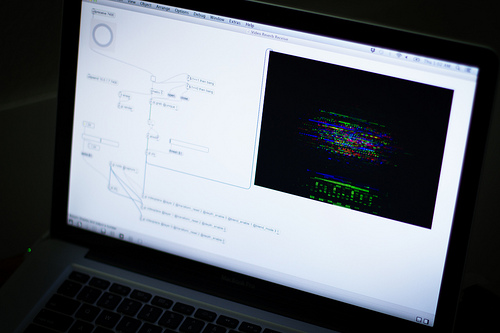
This semester I have two courses with conceptual frameworks that overlap. I'm taking a Media Installations course, and a course called New Systems Sculpture. Media Installations is an exploration of a number of different mediated environments, specially art installations in nature. This course deals with the issues of building playback systems that may be interactive, or may be self-contained. New Systems is taught through the art department, and is focused on sculpture and how video plays as an element in the creation of sculptured environments.

Production image

Gelatin Projection

· One min read
Matthew Ragan
Pixel Pusher

In working with projection mapping I've been interested in experimenting with food and projection. This first experiment is with a milk mixed into gelatin. This resulting surface has a ghostly like quality, and while not ideal, it certainly created an interesting result.

Media Installations | Simple Sync

· 3 min read
Matthew Ragan
Pixel Pusher

Assignment Description

Simple Synch Youtube Rips

Look at the synchronization utility I made in max, and see if you can get at least two computers to synch up some kind of video playback. More computers could be even more interesting.

Production image

Flip Flop Fail

· One min read
Matthew Ragan
Pixel Pusher

Production image

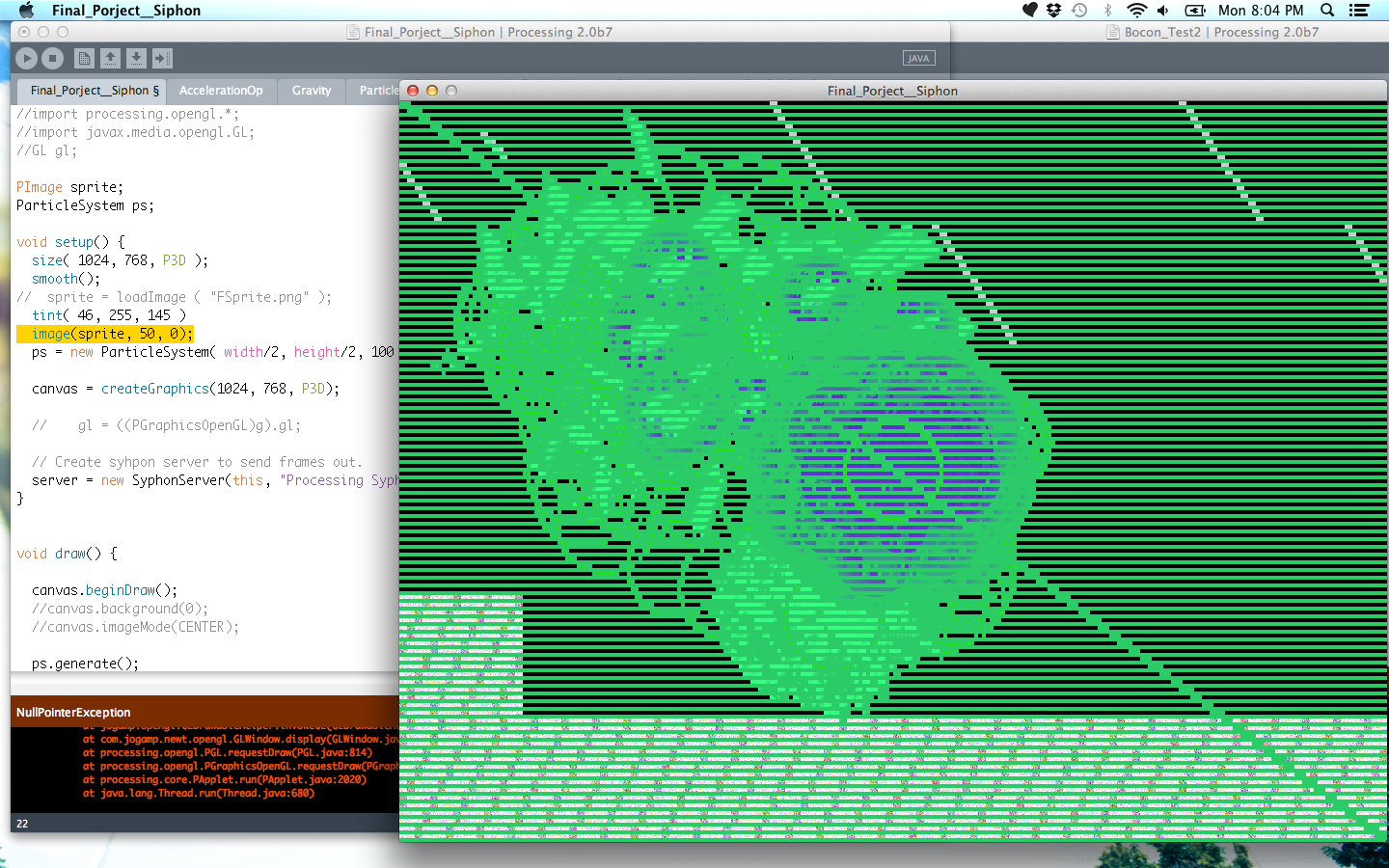
We all fail sometimes, and today I spent most of the afternoon fighting with technology more than understanding it. This screen shots encapsulates a better part of my day. Working on my final project for a programming class, my day was spent in negotiations with a stubborn contraption made of layers of aluminum and plastic. This semester has been very humbling. It's provided for tremendous opportunity, led to great partnerships and friendships, but has also come with late nights and hard lessons. I'm glad to be here, but also glad for a break soon.

The Composite Effect

· 11 min read
Matthew Ragan
Pixel Pusher

Though on first inspection it may be difficult to believe, every media consumable is an artifact born of composited forms. The composite is the leviathan that directly, or indirectly, manipulates the interpretation of cultural forms, and it will only get stranger. The current status of the composite in the creation of cultural forms can be explored by first examining its use in music, the manipulation of images (still and moving), and the growing field of augmented reality. The imminent status of the composite might best be understood by observing the futures suggested by an independent filmmaker and a large manufacturing company.

Shades of White

· 29 min read
Matthew Ragan
Pixel Pusher

a Performative Examination of the works of Ronald King

First Impressions

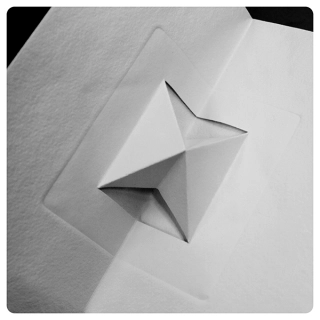
Upon initial inspection, the works of Ronald King are difficult to categorize. Many of his works are collaged arrays of color and text while others are a distilled and minimalistic work of white on white. The dynamic range of his work is further layered by a distinctly performative element that is embedded in the experience of examining one of his artist books. Beyond painting or graphic design, these visceral visual works of miniature paper sculpture compel the viewer-performer to not only experience them, but to enter into a performance with them. Using visual elements that are varied and complex King creates works that are made to be experienced. The pages are not merely representational of a performance, but are instead the script and set for the viewer-performer.

Here I will begin by briefly examining the roots of the visual book. A survey of Keith Smith's Structure of the Visual Book will frame how one to study the components of King's works. Finally, I will critically examine the experience of viewing the white on white compositions by King in connection to the performative nature of his work with the visual book as a medium.
Production image

Race to the End

· One min read
Matthew Ragan
Pixel Pusher

With the semester quickly drawing to a close it's now time for a marathon of writing. This past week was a week of project presentations and the close of Bocon. Sunday was the strike for the show, and in three quick hours, a show that had taken months to design, instal, and program all came down. The strike of a production is always surreal – a strangely destructive frenzy of activity where some pieces of the production are spared and saved, while others are slated for disposal or recycling. Ultimately this very experience is part of the allure of the theatre. Everything is fleeting. Every production is a confrontation with the excitement of creation and a confrontation and surrender to destruction. Everything is transitory and in flux. It's the embodiment of the cyclical rituals we love and loathe.

Production image

What is a Media Designer

· 4 min read
Matthew Ragan
Pixel Pusher

It's difficult to describe what exactly one does as a Media Designer. Prior to this first semester of graduate work I would have likely explained that the work of a media designer is centered around creating artwork that in some way represents and supports the world of the play. I also may well have said that a Media Designer is a person who works to erase the boundaries between the set and projection. A designer who works with light that isn't light in the strictest theatrical sense, a scenic designer who doesn't work with sets in the strictest theatrical sense.

Production image

Almost Open

· 4 min read
Matthew Ragan
Pixel Pusher

¡Bocón! is almost open… it's now so close that you can taste it in the coffee we drink all night while we're working, so close that you can smell it in the hazer fluid that's filling the air. In many ways the transition from the initial days of tech and the final dress seem like an impossible transformation.

Production image

A Review of The Language of New Media

· 8 min read
Matthew Ragan
Pixel Pusher

Photo by Matthew Ragan

The Language of New Media. By Lev Manovich. Cambridge, MIT Press, 2001; 354 pp. $16.71 kindle. What, precisely, is the right term for content that lives with its left foot in a world of traditional gestalts, and its right foot in a mire of experimental methods? How does one characterize the trends that have emerged in the making, distribution, and viewing of media? How does one broadly conceptualize and decode the impact of a digital mechanism as the primary method of cultural expression? These questions frame the narrative in The Language of New Media by Lev Manovich. Heavily constructed around the critical conventions of cinema, Manovich's perspective works to deconstruct the modalities of today's media with an "aim to describe and understand the logic driving the development of the language of new media" (Manovich 7).